10 Types of Piercings You Need to Know About
10 Types of Piercings You Need to Know About
Thinking about getting a new piercing? Before you head to the tattoo parlor, check out these 10 types of piercings you need to know about.
Are you trying to experiment with the canvas that is your body, but you’re not quite ready to make the ’til-death-do-us-part commitment?
Then you’re in luck, because a tattoo’s closest ally is the piercing.
Body Piercings
Piercings are a great way to express yourself creatively: they’re not permanent (unless you want them to be), you can put them almost anywhere, and you can change out the jewelry to fit your mood. That’s just a few reasons why they’re worth considering.
We’ve compiled a list of the types of piercings that you’ll see most commonly – and then some not-so-commons. Ranging from the subtle to the extreme, you’re sure to find something you like here.
Let’s celebrate your unique aesthetic and get pierced!
10 Types of Piercings to Consider
As long as you’re 18 years and older (or younger, with a guardian’s permission), what you get pierced and when is up to you. Go into your session armed with knowledge about your future piercing, and don’t forget to breathe.
We’ve separated the very broad range of piercings into a few key categories. This list of piercings touches the surface.
Ears
You already know about the standard lobe piercings. Those grace the ears of many a six-year-old. Let’s step up our earring game with one of these.
1. Rook
Located right above the ear canal, this piercing sits on the inner part of your ear, hugging the little fold that dips into the canal. A tiny hoop wraps snugly around this area.
2. Tragus
You know that little flap that everybody has right inside their ear? Why not stick a pretty silver bar through it?
Tragus piercings look great with either a hoop or a bar. We recommend piercing with a bar and then changing to a hoop after it’s healed. The bar will allow the piercing more room to breathe and move naturally when cleaning.
Don’t worry. There’s over a dozen other ear piercings to choose from if these two don’t suit your tastes.
Perks of earrings: these are likely to be allowed everywhere, whereas some careers may disapprove of the following types of body piercings.
Facial
For those that can rock any type of piercing (heck yeah!), read on.
3. Eyebrow
If you’re ready to take the piercing plunge, go all out with an eyebrow piercing.
Typically pierced at an angle perpendicular to your brow, earring will bookend the brow hair. In some cases, people choose to get the anti-eyebrow, which is a vertical piercing and located above the cheekbone, acting as an eyebrow itself.
4. Nose
Since the 16th century, nose rings have been celebrated and worn by Indian cultures. Women would pierce one or both sides of their noses and commonly connect their nose rings to an earring by a long chain.
You don’t have to do that – but you can!
Nose piercings will occur on the nostril itself (sometimes two or three on each side, depending on the surface area); in the septum between the nostrils; or on the bridge of your nose, aptly called a bridge piercing.
Mouth
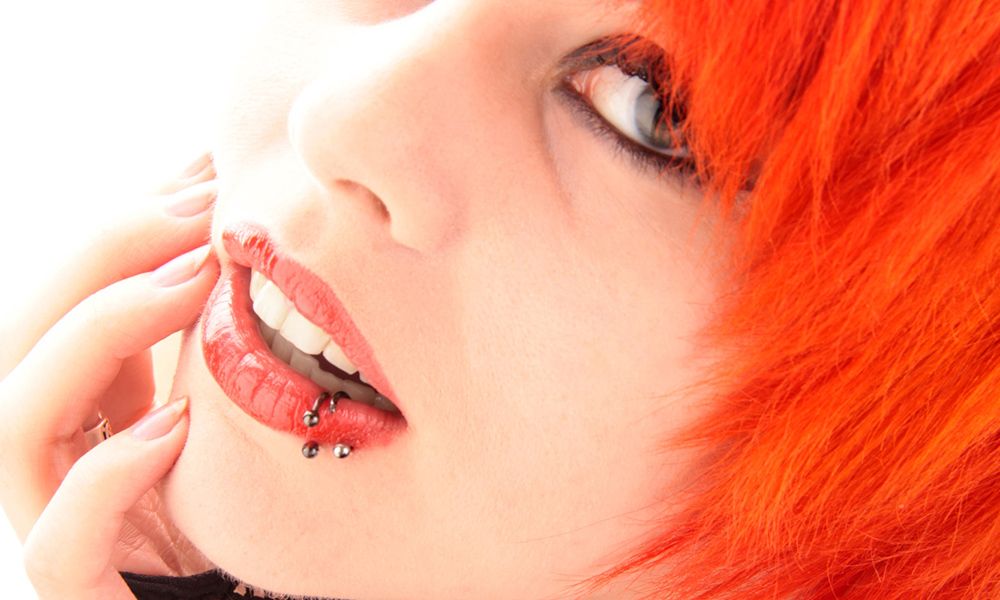
 Oral piercings can be on both the inside and outside of the mouth, occurring on the lips, on the tongue, sometimes even the webbing underneath the tongue or underneath the upper lip.
5. Lip
There’s no shortage of body piercings for your lips.
Don’t get bogged down by all the names. Snake bites. Angel bites. Labret. Just know that the possibilities are there.
6. Tongue
A typical tongue piercing involves one barbell down the middle, careful to not sever any sensitive veins.
Like every other body mod on this list, it’s not limited to just the one. Tongue piercings can occur vertically as well, or can be in multiples. It all depends on you, your body, and the piercer.
Surface
Just like it sounds, a surface piercing is anything that is on the top of your skin, and not hugging a fold or piece of cartilage. Barbell will be shaped much like a staple so that it can reside deeper in the skin.
Because of this, these types of piercings might be at a greater risk for rejecting from the body. If you choose to take that risk, here are some things you could try.
7. Nape of Neck
The back of the neck, a few inches below the hairline, is a common surface piercing area.
The barbell will usually lie horizontally at a convenient spot just before the bones of the spine begin to protrude.
8. Above the Hips
Commonly done on each side, the symmetrical aesthetic of hip piercings can look really nice and dainty. A barbell will typically be pierced at an angle, following the natural V shape of your body.
If you like the idea of these, but want something less invasive, dermals would be your best bet. Having just one point of entry on the skin, they are at less risk of pushing themselves out, also.
Genital
Feeling ballsy? Pun intended.
Then these body piercings will be right up your. . . alley! (What did you think we were gonna say?)
9. Christina
A dainty name for a dainty spot.
A Christina is a vertical piercing located right above the clitoral region, so it will get tucked in with the natural folds of the body. This is also a surface piercing on the top of the skin; piercing the actual clitoris is a lot less common.
10. Frenum
This is a horizontal surface piercing that lies on the underside of the male shaft.
Some people are reading this and thinking: “Ouch!”
Others are thinking: “Bring it on!”
Whatever you decide, proper care and cleaning must be done after each and every piercing.
A Timeless Expression of Self
Piercings have been utilized as a means of self-expression since ancient civilization. Then, it was used to tell stories: who you were, what you did, your social class, and your hierarchy.
Tell your story in any way you’d like. Try out a dainty nose ring. Or get a secret nipple piercing that only you know about.
Piercing culture is thrilling, ever-changing and growing, and if time has told us anything, it’s that these body mods aren’t going anywhere.
With all the types of piercings out there, you’re at no loss for ideas and inspiration. If you’d like to join the ranks of the pierced, contact us for a professional consultation.

Exploring the Bold Elegance and History of Blackwork Tattoos
Blackwork tattoos have been around for centuries and have a simple, bold elegance. Learn about the origins of the style and get inspired for your next tattoo.
Exploring the Elegance and History of Blackwork Tattoos
Roughly 15% of people in the United States have a tattoo. Tattoos have been around for thousands of years. One of the first civilizations to practice tattooing was the Polynesians. Though most cultures have their own traditions and styles of tattooing, only some have seen a revival in the modern day.
Polynesian tattooing is one such tradition that has found new life in an art style known as Blackwork tattoos. But what is Blackwork, and where does it come from? The answer to those questions awaits you below.
What are Blackwork tattoos?
 This isn’t an easy question to answer. The simplest definition is that it’s a style of tattooing that uses large amounts of black ink–hence the name–to create the image of the tattoo.
Oftentimes, Blackwork tattooing incorporates themes and symbols from tribal and geometric designs. It’s also known to have thick lines and uses no color.
Technical definitions aside, describing Blackwork tattoos as ‘a style that uses a lot of black’ is like describing impressionist paintings as ‘made entirely with dots.’ Sure, it’s true, but it only tells us how it’s made, not why it’s done, what it’s about and what inspired it.
Blackwork tattoo artists
This is especially true with Blackwork tattoos because the style as a whole has great range. While some may use it specifically for tribal designs, and others for geometric designs, some artists do both themes and more.
Some artists infuse them with futuristic designs to create an amazing image and a fitting metaphor for the timeless conflict of past versus future, tradition versus change, and where we come from versus where we hope to end up.
History and tradition are important topics when it comes to art. Our perception is heavily based on who we are and what we’ve experienced.
For instance, think of the famous piece American Gothic. Looking at it may bring a lot of different thoughts.
History and tradition
Some viewers might experience national pride. Others may gain a renewed strength against the struggles in their own lives, while others might yearn for a simpler life.
However, knowing that someone created the piece during the Great Depression may change your perspective. Perhaps you don’t see the painting as an image of pride anymore, or strength or simplicity. Perhaps those original feelings are even stronger now.
If things have changed, maybe it’s now an image of fear or hope. The painting seems to say ‘this is all we have and all we know, and we can only hope it’ll be here tomorrow.’
With the relationship between art and perspective in mind, let’s look at the history of Blackwork tattoos.
History of Blackwork
Blackwork traces its origins to the Ancient Polynesians, who used tattoos to identify themselves. Polynesians had tattoos for everything from age, to gender, to the status of the family.
The Polynesians weren’t the first culture to use tattoos for identification. Maori’s are famous for their tattoos. The more tattoos one had, the better warrior they were. Much like the Maori, the Ancient Celts wore their tattoos proudly, and today Celtic symbols are among the most common in tattooing, including Blackwork.
In the latter half of the 18th century, Polynesian tattooing found its way west with the help of the famous Captain Cook.
While in Tahiti
Cook took a liking to the Polynesians’ style of tattooing. When he returned to England, word of the tattoos went with him, and soon tribal tattoos became common among blue-collar Europeans.
It took a while for the practice to become acceptable at other levels of society, but they did catch on. This development is somewhat recent. Ask your parents or grandparents. Chances are, they still remember when soldiers and bikers were the only ones with tattoos.
Originally, tattoo artists inserted ink under the skin with a sharpened instrument. They used a blunt object to tap the back of the sharp instrument, thus depositing the ink under the skin.
Traditional methods
This is the process modern tattooing is based on. Even so, some tattoo artists still insist on the traditional method.
Among this latter group are many of the peoples whose traditions inspired modern tattoos, practicing their traditions in the same way they have always done. We should preserve traditions, even with the passing of time.
With the advancement of technology and the changing of attitudes over time, tattoos are more prevalent, and today a large percentage of people have them.
As the popularity of tattoos increased, so did the creativity put into them. What was once a style exclusively based on Polynesian and other tribal designs has now evolved into a genre all its own
Tattoo it Black
The word ‘tattoo’ comes from a Tahitian word, and, in a way, it is the perfect metaphor for the artwork it describes. Many cultures use tattoos for different purposes.
The Romans used them to identify servants and slaves. Egyptian women used them for healing and to symbolize their status as a priestess. Polynesians had tattoos to represent everything about themselves, from who they were to who they loved.
In these past few hundred years, tattoos have spread across the world. Styles are often preserved, altered, and re-purposed. Blackwork tattoos have gone from traditional to a beautiful hybrid of tradition and the present.
Black Ink Tattoos
In its signature black ink, you can find structure and freedom, familiarity and mystery.
Through the years, tattoos, and even the word ‘tattoo” has not changed completely. Through it all, there has been one constant, started in Polynesia and kept around the world: tattoos are about identity.
They tell the world who we are and what’s important to us. They are a reminder amidst all the confusion, something permanent in an ever-changing world.
If you want to learn more about tattoos or where you can get one, please contact us. We have locations in Las Vegas, Henderson, Nevada and Maui, Hawaii.
How to Prepare for Your First Tattoo
Getting your first tattoo is both exciting and potentially nerve racking. Here’s what you need to know before getting a tattoo and how to care for it after.
Are you ready to join the 45 million Americans who have at least one tattoo?
 Getting a tattoo can be a fun, memorable experience, but it can also go wrong very quickly if you’re not prepared.
If you want your first tattoo experience to be a good one, read on for some tips to help you prepare for the big day.
Choosing Your First Tattoo
The first step to having a great tattoo experience is choosing a tattoo design that you absolutely love. Don’t rush yourself. Take your time researching designs and figure out exactly what you want.
Remember, this design is going to be on your body for life, so you need to make sure you won’t get sick of it.
Talk to a Tattoo Artist
If you have an idea for a tattoo but aren’t sure how to articulate it, you might want to consider sitting down with a tattoo artist for some help putting it together.
Even if you do know exactly what you want, it’s still helpful to sit down with a professional. They can provide guidance and give you their professional opinion on the design.
Find the Right Shop
Not all tattoo shops are created equal. Take your time looking for one that employs qualified artists with a good reputation.
Be sure to read online testimonials to see what people are saying about a particular shop and its artists before you go there for your first tattoo.
Think about Placement
Tattoos are big commitments, especially when you choose somewhere highly visible for your first one. Face/hand/neck tattoos definitely aren’t for everyone.
Depending on your lifestyle and the field in which you work, it might be in your best interest to get your first tattoo in a more discrete location.
Remember You Get What You Pay For
When you meet with an artist and have your tattoo drawn up, they should give you an estimate of what it will cost.
Tattoos are expensive, and, when you hear a high number, it can be tempting to try and find someone who will do the same tattoo for less.
As with most things in life, you get what you pay for with tattoos. A good tattoo from a talented artist will cost more than a subpar finished product. But, it will be worth it when you have a tattoo that you want to show off.
A Few Days Before Your Appointment
There are some things you can do in the days leading up to your appointment that will help you have a better experience, including the following:
- Avoid the sun: Sunburned skin isn’t just painful, it also can affect the outcome of your tattoo
- Moisturize: Dry or uneven skin is difficult for artists to work with and can cause your tattoo to come out less clear
- Get a doctor’s note: If you have any conditions that could affect you during the tattoo process, you’ll legally need your doctor to give you the go-ahead
Remember, there’s no need to rush to get a tattoo. The wait for your sunburn to go away or for your skin to clear up will be worth it if you get a better end result.
The Day Before Your Appointment
Keep these tips in mind to set yourself up for a successful appointment:
- Avoid alcohol: High blood alcohol levels will thin the blood and lead to excessive bleeding during your appointment
- Stay hydrated: This will keep your skin moisturized and help you stay alert
- Get plenty of sleep: Being unrested might make you more fidgety, which can affect the outcome of your tattoo
Don’t forget to make sure you have enough money on hand, too. In addition to the cost of the tattoo, you may also need to pay for food, aftercare products, parking, and a tip for the artist.
The Day of Your Appointment
On the day of your appointment, make sure you’re prepared with these items:
- ID: If you look like you might be younger than 18, the shop will need to confirm your age when you arrive for your appointment
- Bag of essentials: Bring a small bag with a snack, a charged cell phone, water, and maybe a pair of headphones if you want to listen to music or a podcast during the appointment
You’ll also want to do the following to make sure you’re in a good physical state:
- Eat before your appointment: Getting a tattoo is stressful on your body, and you’ll need to keep your blood sugar up to avoid getting dizzy or nauseous, especially if you’re getting a large tattoo
- Take a shower: Clean skin is better for tattoos, and your artist will appreciate you cleaning up before the appointment
- Wear old clothing: It’s likely that some ink will get on your clothes, so you don’t want to ruin anything that’s new or expensive
- Don’t shave: You don’t want to show up with razor burn or cuts — if your skin needs to be shaved, the artist will do it
- Avoid caffeine: This will probably make you shaky or jittery, which will make things harder for the artist
Finally, take some time to check your attitude before you go to your appointment. Accept that there will be some pain. It’s unavoidable when you’re getting a tattoo.
But, if you go in with a positive attitude and believe in your ability to handle the pain, you’ll be more likely to make it through the session.
Taking Care of Your First Tattoo
In addition to preparing for your appointment, you should also be prepared to care for your first tattoo once it’s finished.
Proper aftercare is essential if you want your tattoo to last. Some things you’ll need to do after getting your tattoo include:
- Remove the bandage in a clean bathroom after two or three hours
- Once the bandage is removed, wash the tattoo immediately with warm soap and water
- Only wash your tattoo with clean hands
- Apply a healing ointment like Aquaphor to keep your tattoo moist
- Don’t panic when your tattoo starts to “weep” in the days after your appointment
If you have any healing-related issues, be sure to call the artist who gave you your tattoo. They’ll give you proper instructions for caring for the issue.
Are You Ready for Your First Tattoo?
Now that you know how to prepare for your first tattoo, it’s time to pick your design and start planning!
If you live in or around Las Vegas, Henderson, or Maui and are looking for a qualified artist contact us at Skin Factory Tattoo and Body Piercing to schedule an appointment or meet with one of our artists.
Stop by our Maui Tattoo Shop or Henderson Tattoo Shop

Tribal Tattoos: Why Are They So Popular?
Tribal Tattoos: Why Are They So Popular?
 From ancient times to the modern era, tribal tattoos have remained popular throughout the years. Learn more about why this popular style has stuck around.
Did you know that over 45 million Americans have at least one tattoo?
Some get tattoos as a means of self-expression. For others, tattoos make them feel sexy, rebellious, or daring.
While we can’t say for certain which tattoos are the most common, tribal tattoos definitely rank high on the popularity list.
What makes the tribal tattoo design so popular? How did they get started? What meaning did they have in the past–and what meaning do they hold today?
In this post, we’ll delve into the fascinating history of tribal tattoos. Read on to learn more!
The History of Tribal Tattoos
Long before Samuel O’Reilly invented the tattoo gun in 1891, cultures around the world had embraced the art of the tribal tattoo.
Consider a few examples.
Egypt
Historians have found tattoos on mummies in northern Africa that date back to around 2000 BC. In ancient Egypt, it was common practice for the High Priestesses to decorate their bodies with tattoos, especially on their arms.
Other mummies have been found with tattoos that are thought to relate to fertility, rejuvenation, and sun worship. It was also believed that tattoos could ward off evil spirits and cure certain diseases.
Polynesia
Almost everyone in ancient Polynesian cultures–male and female–was tattooed. Tattoos were used to identify tribe, rank, genealogy, and sexual maturity. Tattoos were also closely linked with warfare and religious rituals.
Tribal tattoos were part of life in many different Polynesian cultures, including Samoa, Tonga, Hawaii, and New Zealand. In fact, the word “tattoo” first entered Europe after explorer James Cook returned from his voyage through Tahiti and New Zealand in 1771.
Britain
Britain may not immediately come to mind when you imagine a tribal tattoo. But the elaborate Celtic knots and crosses date way back to before Christianity ever reached its shores.
The “Picts” were an ancient people whose name literally meant “painted people.” Aside from crosses and knots, common Celtic designs include birds, trees, and other aspects of nature.
Central America
In ancient Aztec society, tattoos were used as symbols of social status and war achievements. Warriors often had tattoos of deities, which were believed to give them divine protection during battle.
Ghosts, demons, and wild animals are other popular tribal tattoo designs throughout central America. The Mayan calendar, which predicted the end of the world would come in 2012, is another popular design.
Southeast Asia
In Thailand and other parts of Southeast Asia, you’ll see monks and tourists alike sporting sacred “Sak Yant” tattoos. These eye-catching designs incorporate geometric patterns, animal images, ancient Buddhist prayers, and magical Khmer scripts.
The practice goes back thousands of years to when it was believed these tattoos would protect warriors in battle. The tattoos were created using bamboo–a practice still common in that part of the world today.
Modern Tribal Tattoo Designs & Meanings
As you can see, the art of the tribal tattoo transcends time, culture, and continents. They were used for centuries to identify, protect, and empower those who wore them.
Of course, most of us today don’t believe that tattoos offer magical powers or protection from evil. Most people select tribal tattoos for their aesthetic beauty or to celebrate their cultural heritage.
Still, if you’re considering a tribal tattoo for yourself, it’s interesting to know the origin of the design.
For example, some of the most popular tribal tattoo designs are Samoan in origin. These abstract or geometric designs are generally black and may include animals, sun rays, or ocean swirls.
Tribal tattoo designs on the face are typically Maori. Originating in New Zealand, these striking tattoos are synonymous with rank, prestige, and social status.
Other popular tribal tattoo designs and patterns include:
- Abstract patterns
- Geometric designs
- Swirls
- Crosses
- Vertical masks
- Shields
- Dragons
- Butterflies
- Tigers
- Centipedes
- Spiders
- Phoenix bird
There’s virtually no limit to the design you can create for a tribal tattoo. That’s why it’s essential to find a talented tattoo artist who can create the perfect tattoo for your vision.
Considerations for Your Tribal Tattoo
Before you make any final decisions about your tribal tattoo, here are a few important factors to consider:
Style
Tribal tattoos can be soft, swirling, and looping. They can also be bold and jagged with hard edges.
Which style feels right for you? You might also consider a blend of the two for a more unique look to your tattoo.
Color
Many people associate tribal tattoos with solid black, which they certainly can be.
But have you considered any shading or shadows? What about one or more colors to accent the main parts of your design?
You can also go with full, bold colors to really make your tribal tattoo stand out. There’s no right or wrong answer–it’s whatever what you want it to be.
Location
A final consideration is where you’re going to place your new tattoo on your body. The upper arm or lower leg are popular choices for tribal tattoos, but they’re not the only ones.
Men might consider a tattoo that stretches across their upper back or creates a sleeve on their forearm. Women can get creative with placement on their lower back, foot, or hand.
Ready for Your Next Tattoo?
Now that you know more about tribal tattoos, how are you feeling? Are you ready to create a tribal design that’s perfect for you?
We invite you to contact us to discuss your ideas with one of our professional tattoo artists. Whether you’re in Las Vegas, Henderson, or Maui, we’ve got you covered.
Wondering what we’re all about? Check out our testimonials page to see what our satisfied customers have to say about our work.
Stop by our Maui Tattoo Shopor Henderson Tattoo Shop
How to Guide: New Tattoo Care
How to Guide to New Tattoo Care
Your brand new tattoo requires a certain amount of tattoo care to promote healing, prevent infection, and keep it fresh for longer. Here’s how to do it.
You’ve got a new tattoo. Congratulations! Feeding the ink addiction is always exciting, and you probably can’t wait to show off your new art.
But before your tattoo is going to be ready to be on public display, you’ll have to get through the healing process. Whether this is your first tattoo or one of many, you’ll want to make sure you’re practicing proper tattoo care ever time.
Proper after-care ensures your tattoo doesn’t get infected, that it heals well, and that it stays vibrant and fresh for as long as possible.
Keep reading for the complete guide to tattoo aftercare.
Day 1
First-day care determines the trajectory of your entire healing process. It’s also split into to two separate, but equally important steps.
At the Shop
The first thing your tattoo artist is going to do is apply a thin layer of petroleum jelly over your tattoo and apply a bandage or clear covering over your tattoo.
You want to leave this on. No matter how much you want to look at your tattoo, leave the bandage on until you’re ready to wash the tattoo.
Once You Get Home
There’s some wiggle room here, as you can wash your tattoo after a few hours or leave the bandage on for 24 hours before washing.
Do what works best for you.
When it comes time to wash your tattoo, remove the bandage slowly and carefully, being careful not to pull if it’s stuck. If your bandage does stick to your tattoo, run some water over it (gently). It should come free.
Your tattoo may be a little tender, so be gentle here. Use a mild antibacterial soap or special tattoo soap to carefully wash your tattoo. If you don’t use a specially formulated tattoo soap, make sure to use a soap free of hydrogen peroxide, dyes or fragrances. The simpler, the better.
Don’t scrub and don’t use a loofah or cleansing cloth.
Rinse the tattoo and pat it dry with a clean towel.
You’ll want to leave it uncovered at bedtime and sleep on sheets you don’t mind getting dirty. The tattoo may ooze ink and plasma for a day or two.
Day 3 – 4
Now the scabbing starts.
Some folks get full on hard scabbing, while others only see flaking like you would with a sunburn. Regardless, the tattoo care steps are the same.
Once the scabbing or flaking sets in, use a tattoo lotion to keep the tattoo moisturized. As with the soap, you can use special tattoo lotions or just a simple, dye-free, fragrance-free lotion from the drugstore.
It’s important NOT TO PICK at the scabs. Doing so will fade your tattoo and can put you at risk for infection. They will flake off on their own, so just keep moisturizing.
You’ll need to keep the tattoo clean during this time, but you also don’t want to scrub it directly with the soap, as this can scrape away the flaking and scabbing.
Instead, wash above and around the tattoo, and allow the soapy water to run over the tattoo. Continue to pat dry.
When you’re out and about, make sure you’re wearing loose clothing so the tattoo can breathe, but don’t expose it to direct sunlight.
Day 7 – 10
You’ll start noticing the itching about now. As the tattoo heals, it’s going to itch like crazy.
First things first: DON’T SCRATCH.
Scratching not only tears away any remaining scabs, it also creates tiny cuts in the skin that invite skin infection. The whole point of tattoo care is to avoid infection, so don’t scratch.
Instead, you can apply gentle pressure with a cloth. Some artists will even recommend lightly patting the area to relieve the itch.
Other than that, just keep moisturizing, and keep it clean. Once the scabbing is completely gone, you can start washing the tattoo directly, but again, don’t scrub.
Day 12 – 14
At this point, your tattoo should be pretty close to completely healed. Scabbing should be done, and you shouldn’t be noticing any leaking ink or plasma.
Continue wearing loose clothing and keep the tattoo out of the sun for at least two weeks. You should also avoid swimming or submerging your tattoo for the first two weeks.
Stay away from hot water, too, even in the shower. It can fade the ink.
And Beyond
Once the tattoo is fully healed, after 2 – 4 weeks, your initial tattoo care is done! You made it!
Since tattoos are an investment, though, your tattoo care doesn’t stop there.
You can ditch the loose clothes and you can start taking long baths and swimming again. But there are a few things you should always do, to keep your tattoo looking bright and fresh.
First, moisturize it. You should be moisturizing your skin anyway, so just make sure the tattoo is getting some love when you moisturize the rest of your skin, especially if you live in a very cold or very dry climate.
Second, make sure that if your tattoo is going to be exposed to the sun, you use sunscreen. This is very important when the tattoo is newly healed but is also a good rule of thumb going forward.
Tattoo Care is a Lifestyle
If you continue getting tattoos (and many do. They can be addictive), tattoo care will eventually feel routine.
Just keep in mind that tattoos are a big investment. Baby them and the skin they’re on.
For more on the best tattoos in Las Vegas, contact us here so we can get started on your next work of art.